
Mission
With Saint Joseph as our sponsor, guide, and foster-father, the Sons of Saint Joseph are Christian men who hope to overcome all same-sex attractions and any persistent attachments to the homosexual or the “gay” orientation. This will be accomplished through: frequent reception of the Sacraments, daily prayer, spiritual direction, self-sacrifice, corporal and spiritual works of mercy, professional counseling, and by developing the virtues of prudence, temperance, and courage. In doing so, we wish to further our own personal relationship with Jesus Christ, and, as a consequence, become living examples for our brothers who are still trapped within the homosexual lifestyle and within the false “gay” orientation.
- We accept Our Lord Jesus Christ as our One and Only Savior.
- We accept that only through the Infinite Power and Mercy of Jesus Christ can we be fully healed of homosexual desires.
- We accept Saint Joseph, the foster-father of Our Lord, as our gracious benefactor in Heaven.
- We look towards Our Blessed Lady, the Theotokos, as the model of humility, obedience, and purity.
- We believe and acknowledge that God created us as whole men; we were not born “gay.”
- We acknowledge that homosexual acts are not part of God’s plan for nature, humanity, or ourselves.
- We acknowledge that the homosexual inclination is a part of our wounded false-self that can be healed.
- We acknowledge that all unmarried persons are called to chastity.
- Attendance at Divine Liturgy every Sunday and on Holy Days of Obligation; and during the week when possible.
- Daily prayer and meditation (a minimum of one hour) which should include at least one of the following:
- The Jesus Prayer, Eucharistic Adoration (if you are a Roman Catholic,) reading from Holy Scripture, studying the lives and writings of the Saints, especially those works related to our Patron Saint Joseph, recitation of the Holy Rosary, the Chaplet of Divine Mercy, and the Chaplet or Novena to Saint Joseph. For more information see Fr. Donald Calloway’s “Consecration to St. Joseph.”
- Set up an “icon corner” in your house or bedroom; specifically with an icon of Saint Joseph or an icon from the life of Christ which includes Saint Joseph; for example, The Birth of Christ or The Presentation in the Temple.
- Going about our daily work as did Saint Joseph: with a countenance of fortitude, humility, and silence.
- Some sort of propitiation: fasting, abstinence, self-denial (avoiding television, computer games, the internet, or another enjoyment).
- Custody of the eyes: keeping our gaze away from that which is an occasion of sin.
- Daily Thanksgiving to Our Lord Jesus Christ.
- Daily Act of Contrition.
- The Saint Joseph Prayer.
- To accept and admit to ourselves and to God that we have been wounded
- To forgive those who hurt us.
- To understand why we looked towards homosexuality and the “gay” lifestyle as an answer to all our questions.
- To eventually heal those old injuries.
- To help others escape the “gay” lifestyle and the trap of homosexuality.
- To live our lives as a perpetual sacrifice; not only for our own “Christian perfection,” but in reparation for those sins committed by all homosexuals.
- To become more and more like our foster-father Saint Joseph; to become models of manly virtue, protectors of the weak and the persecuted, and to become obedient servants of Christ and Our Lady.
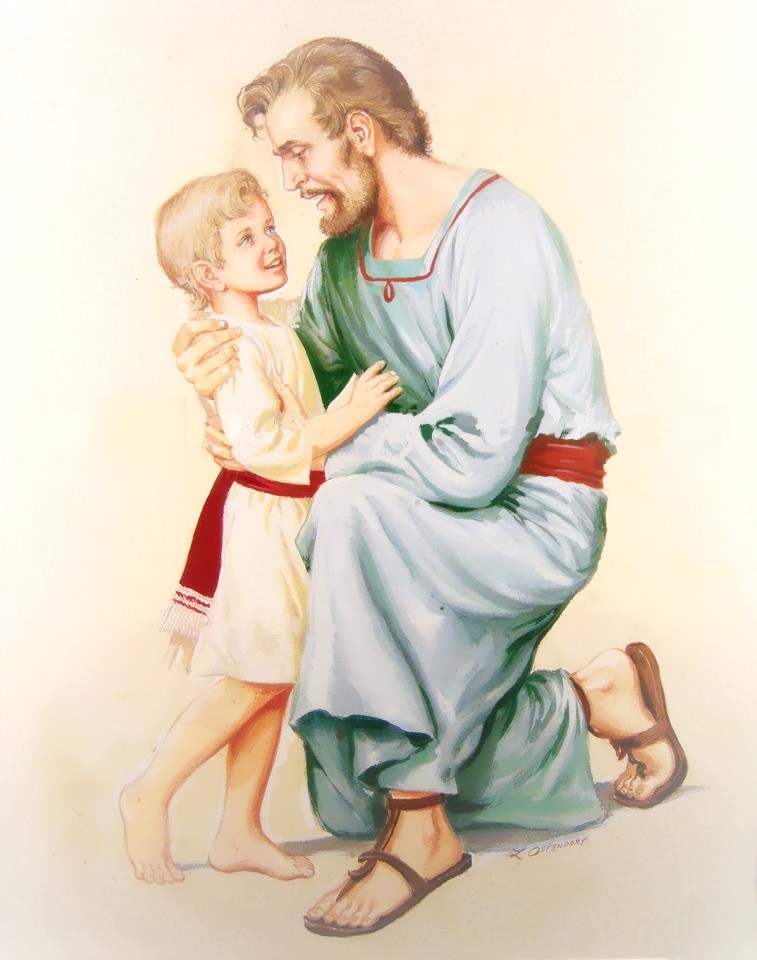
Oh St. Joseph whose protection is so great, so strong, so prompt before the Throne of God, I place in you all my interests and desires.
Oh St. Joseph do assist me by your powerful intercession and obtain for me from your Divine Son all spiritual blessings through Jesus Christ, Our Lord; so that having engage here below your Heavenly power I may offer my Thanksgiving and Homage to the Loving of Fathers.
Oh St. Joseph, I never weary contemplating you and Jesus asleep in your arms. I dare not approach while He reposes near your heart.
Press Him in my name and kiss His fine Head or me, and ask Him to return the kiss when I draw my dying breath.
St. Joseph, Patron of departing souls, pray for us.
Amen
Saint Joseph, model of manly strength, obedience, and chastity
Just as you defended and sheltered the child Jesus
Who God the Father so rightly placed in your loving care
I ask you to be my foster-father and protector.
Joseph most strong,
I humbly implore you to pray for my intentions:
That, with your help, I may embody the teachings of Christ
That I will always remain pure in body, mind, and spirit,
And that I will have the strength to heal from the pains of childhood
And from those wounds I inflicted upon myself.
Deliver us from all same-sex attraction
And make us the whole men that we were born to be.
Joseph most just,
Joseph most chaste,
Joseph most prudent,
Solace of the wretched,
Hope of the sick,
Terror of demons,
Pray for me.
Amen.
Frequently Asked Questions
It is better, when asked, or when giving testimony, to describe yourself as a Orthodox, Christian, or a Catholic man who experiences (or experienced in the past) “same-sex attraction.” To self-identify as “gay,” no matter the intentions of your heart, is to publicly align oneself with a socially and historically charged word: in the past, “gay” simply meant happy or joyful; since the acquisition of the word by the modern homosexual movement, “gay” is identified with such things as “gay” sex, “gay” marriage, and “gay” porn. Therefore, to identify as “gay” or LGBTQ is to bind ourselves to both a cultural and political movement that is essentially anti-truth. Fr. Thomas Hopko in his book “Christian Faith and Same-Sex Attraction,” wrote:
“While sexuality that may be expressed in properly ordered heterosexual feelings and actions is an essential element in human being and life, sexual desires for carnal relations with persons of one’s own sex are not a part of a person’s basic sexual identity as a human being…all men and women, whatever their sexual feelings, proper and improper, are human beings who cannot be essentially defined in their God-given humanity by their feelings and desires—feelings and desires that have been produced in them by their biological, psychological, and cultural inheritance, and by the way they have been treated by others, particularly their parents and family members, within the corrupted conditions of the fallen world.”
Metropolitan of Nafpaktos Hierotheos, in his book “Orthodox Therapy: The Science of the Fathers,” wrote:
“…in order to be cured it is essential to feel that one is ill. When someone who is sick is not aware of his illness, he cannot turn to a doctor. Self-knowledge is one of the first steps to a cure. St. Maximus teaches: ‘The one who has come to know the weakness of human nature has gained experience of divine power,’ and he is eager to achieve some things and has achieved other things through this divine power.”
In 1973, the American Psychiatric Association declassified homosexuality as a mental disorder. The American Psychological Association Council of Representatives followed in 1975. Thereafter other major mental health organizations followed, including the World Health Organization in 1990. Yet, before and since, evidence continues to determine that homosexuality is indeed a mental illness. The way in which most contemporary researches get around this fact is by blaming the high rates of psychiatric morbidity in homosexuals to social and cultural homophobia, internalized homophobia, and overall that homosexuality and mental illnesses are unrelated with the unusual rates of serious psychological conditions seen in homosexuals as “possibly linked with discrimination.” Only, this supposition is categorically false, for in the Netherlands, the first country in the world to legalize same-sex marriage, in particular, gay men continue to exhibit a plethora of various mental disorders.*
Part and parcel along with any authentic program of healing from same-sex attraction, there must be at least a cursory examination of any childhood trauma, neglect, or abuse that was experienced by the person now dealing with same-sex attraction. Because some have survived particularly intense or violent abuse as children, professional therapy is highly advised; others, with a different story, perhaps therapy is not as necessary. Here, it is not that mental illness causes homosexuality, but that the oftentimes extreme difficulties which some men experienced as children, who later become same-sex attracted, will eventually exhibit various mental illnesses because homosexuality never fully resolves the unattended wounds; Dr. Joseph Nicolosi put it this way: homosexuality is a “symptomatic failure to integrate self-identity. Symptoms will always emerge to indicate its incompatibility with a man’s true nature.” Ultimately, the decision to seek therapy is up to the individual; although it is possible, outside of a clinical environment, to naturally experience a diminishing of same-sex desires, and, henceforth, to witness an increase in attraction towards the opposite sex. Reparative therapy, while extremely beneficial to many, is not for everyone.
* “Despite the Netherlands’ reputation as a world leader with respect to gay rights, homosexual Dutch men have much higher rates of mood disorders, anxiety disorders and suicide attempts than heterosexual Dutch men. Epidemiologists report similar disparities elsewhere in Western Europe and North America.”
“Exploring a Dutch paradox: an ethnographic investigation of gay men’s mental health.”
Aggarwal S & Gerrets R
Culture, Health & Sexuality 16:105-119, 2014.
Other studies:
“Of the 1285 gay, lesbian and bisexual respondents who took part, 556 (43%) had mental disorder as defined by the revised Clinical Interview Schedule (CIS-R). Out of the whole sample, 361 (31%) had attempted suicide…Gay, lesbian and bisexual men and women have high levels of mental disorder…”
“Rates and predictors of mental illness in gay men, lesbians and bisexual men and women
Results from a survey based in England and Wales”
James Warner, et al.
British Journal of Psychiatry (2004), 185, 479-485.
“LGB people are at higher risk of mental disorder, suicidal ideation, substance misuse, and deliberate self-harm than heterosexual people.”
“A systematic review of mental disorder, suicide, and deliberate self-harm in lesbian, gay and bisexual people.”
Michael King, et al.
BMC Psychiatry. 2008; 8: 70.
“Self-reported identification as non-heterosexual (determined by both orientation and sexual partnership, separately) was associated with unhappiness, neurotic disorders overall, depressive episodes, generalized anxiety disorder, obsessive-compulsive disorder, phobic disorder, probable psychosis, suicidal thoughts and acts, self-harm and alcohol and drug dependence.”
“Mental health of the non-heterosexual population of England.”
Chakraborty A, et al.
Br J Psychiatry. 2011 Feb;198(2):143-8.
“Gay/lesbian and bisexual respondents had higher levels of psychopathology than heterosexuals across all outcomes. Gay/lesbian respondents had higher odds of exposure to child abuse and housing adversity, and bisexual respondents had higher odds of exposure to child abuse, housing adversity, and intimate partner violence, than heterosexuals. Greater exposure to these adversities explained between 10 and 20% of the relative excess of suicidality, depression, tobacco use, and symptoms of alcohol and drug abuse among LGB youths compared to heterosexuals. Exposure to victimization and adversity experiences in childhood and adolescence significantly mediated the association of both gay/lesbian and bisexual orientation with suicidality, depressive symptoms, tobacco use, and alcohol abuse.”
“Disproportionate exposure to early-life adversity and sexual orientation disparities in psychiatric morbidity.”
McLaughlin KA, et al.
Child Abuse Negl. 2012 Sep;36(9):645-55.
“Compared with heterosexual respondents, gay/lesbian and bisexual individuals experienced increased odds of six of eight and seven of eight adverse childhood experiences, respectively. Sexual minority persons had higher rates of adverse childhood experiences compared to their heterosexual peers.”
“Disparities in adverse childhood experiences among sexual minority and heterosexual adults: results from a multi-state probability-based sample.”
Andersen JP, Blosnich J.
PLoS One. 2013;8(1):e54691.
“The studies reported childhood sexual abuse (CSA), childhood physical abuse (CPA), childhood emotional abuse (CEA), childhood physical neglect, and childhood emotional neglect. Items of household dysfunction were substance abuse of caregiver, parental separation, family history of mental illness, incarceration of caregiver, and witnessing violence. Prevalence of CSA showed a median of 33.5 % for studies using non-probability sampling and 20.7 % for those with probability sampling, the rates for CPA were 23.5 % (non-probability sampling) and 28.7 % (probability sampling). For CEA, the rates were 48.5 %, non-probability sampling, and 47.5 %, probability sampling. Outcomes related to SCE in LGBT populations included psychiatric symptoms, substance abuse, revictimization, dysfunctional behavioral adjustments, and others.”
“Stressful childhood experiences and health outcomes in sexual minority populations: a systematic review.”
Schneeberger AR, et al.
Soc Psychiatry Psychiatr Epidemiol. 2014 Sep;49(9):1427-45.
“Among 287 participants, 211 (73.5%) reported experiencing [child physical abuse] CPA before the age of 17…”
“Association between Childhood Physical Abuse, Unprotected Receptive Anal Intercourse and HIV Infection among Young Men Who Have Sex with Men in Vancouver, Canada”
Arn J. Schilder, et al.
PLoS One. 2014; 9(6): e100501.
“The research results indicate that, as compared with the group of heterosexual individuals, in the group of homosexuals there occurs a worsening in psychological functioning, which may be also manifested by an increased indirect self-destructiveness index. The increased intensity of indirect self-destructiveness in homosexual individuals may be considered a manifestation of worsened psychological functioning.”
“Indirect self-destructiveness in homosexual individuals.”
Tsirigotis K, et al.
Psychiatr Pol. 2015 May-Jun;49(3):543-57.
The first thing one must do is go to the Sacrament of Confession. Afterwards, it is best to find a permanent spiritual director because the tendency for many men with porn and masturbation addictions is to “Confession hop;” going from parish to parish because they are embarrassed to habitually confess the same sins over and over again. Having a single spiritual director keeps us honest and working towards freedom from these pervasive sins, rather than becoming trapped within a cycle of Confession, relapse, Confession, and relapse.
Secondly, one must remove the source of temptation; if you were an alcoholic you would not keep liquor in your house? Therefore, if you are addicted to porn, you do not want any internet access within your reach. This will be difficult in the age of social media, but it’s a necessity; this is particularly important because the majority of men self-abuse with pornography in the evening while at home. During those hours, keeps busy: go out with friends, find a good spiritual work to read, devout a certain amount of time to prayer; when the temptation is exceptionally strong: reach out to a trusted friend, if there is a Perpetual Adoration chapel in your area – go there; whatever you do – stay away from the computer.
Lastly, as a part of freeing ourselves from the addiction to porn, one must discover why we are drawn to porn, and, above all, why you are drawn to certain images. In this process of discovery, we can tie our current desires with past trauma; for instance, an obsession with so called “daddy porn” can be crucially interrelated with our failure to connect with our own fathers during childhood. Then, in this realization, and once we start cleansing and bandaging those original inner wounds, the images gradually begin to lose their power because the trauma from which they stem from is being healed. This is a painful process, but a totally necessary one; according to St. Nikolai Velimirovich: “What does it mean to take up your cross? It means the willing acceptance, at the hand of Providence, of every means of healing, bitter though it may be, that is offered. Do great catastrophes fall on you? Be obedient to God’s will, as Noah was. Is sacrifice demanded of you? Give yourself into God’s…”
No. St. Paul wrote: “Do not be deceived. Neither fornicators, nor idolaters, nor adulterers, nor homosexuals, nor sodomites, nor thieves, nor covetous, nor drunkards, nor revilers, nor extortioners will inherit the kingdom of God.” There are no distinctions made between sins as to their seriousness; to make such a differentiation would be presumptuous. In addition, masturbation and pornography often contribute to a further entrenchment of the homosexual orientation as we continually fantasize and watch pornography which only succeeds in feeding our initial insecurities about the same-sex. Lastly, masturbation and pornography will also inevitably lead to a spirit of boredom and dissatisfaction that can push one towards sexual activity with another person. According to Fr. Johannes L. Jacobse: “Porn comes from the depths of hell, and is calculated to destroy the characters of young men before they even have a chance to grow into a healthy sense of who they are and what they can become. Once your mind becomes pornified…two things gradually happen: You lose any higher sense of self, and your relationships become distorted.”
Saint Joseph was a man of few words; in fact, none are recorded in Holy Scripture. But, he was a man of action. Only, Joseph did not represent a sort of boastful or egotistical type of false masculinity, but he was of a subtle and deliberate nature which always remained in supplication to the Will of God. When God spoke, Joseph listened. Like his Old Testament namesake, Joseph was a dreamer. Yet, he never indulged in a lethargic form of self-centered star-gazing, but kept vigilant in his conscious openness to every whisper emanating from the mind of the Father. According to St. Ephrem, one of the Eastern Fathers of the Church, St. Joseph once said: “Who has made me worthy of so tremendous an honor that the Son of the Most High should be a son to me? David my forefather bore a diadem, but I, thrown down from that honor, have come upon utmost contempt; and him whom lineage destined to be a king chance has made a carpenter. But now the crown that was snatched away has returned after Thou, the King of kings, hast come into my arms.”
Other such examples of manly Christian humility include: St. Alexius of Rome, St. Sergius of Radonezh, Saint Nektarios of Aegina, St. John Kronstadt, and Brother Joseph Munoz-Cortes.
Blog
Same-Sex Attraction and Childhood Sexual Abuse – The Evidence
In the 21st Century, LGBT activists and their allies have repeatedly claimed that gay people are born gay; and trans people are born in the wrong body. But there is no evidence to substantiate any

Why Men are Drawn to Orthodoxy: My Conversation with Fr. Michael Butler
https://www.youtube.com/watch?v=lvZr8Wl0ivk
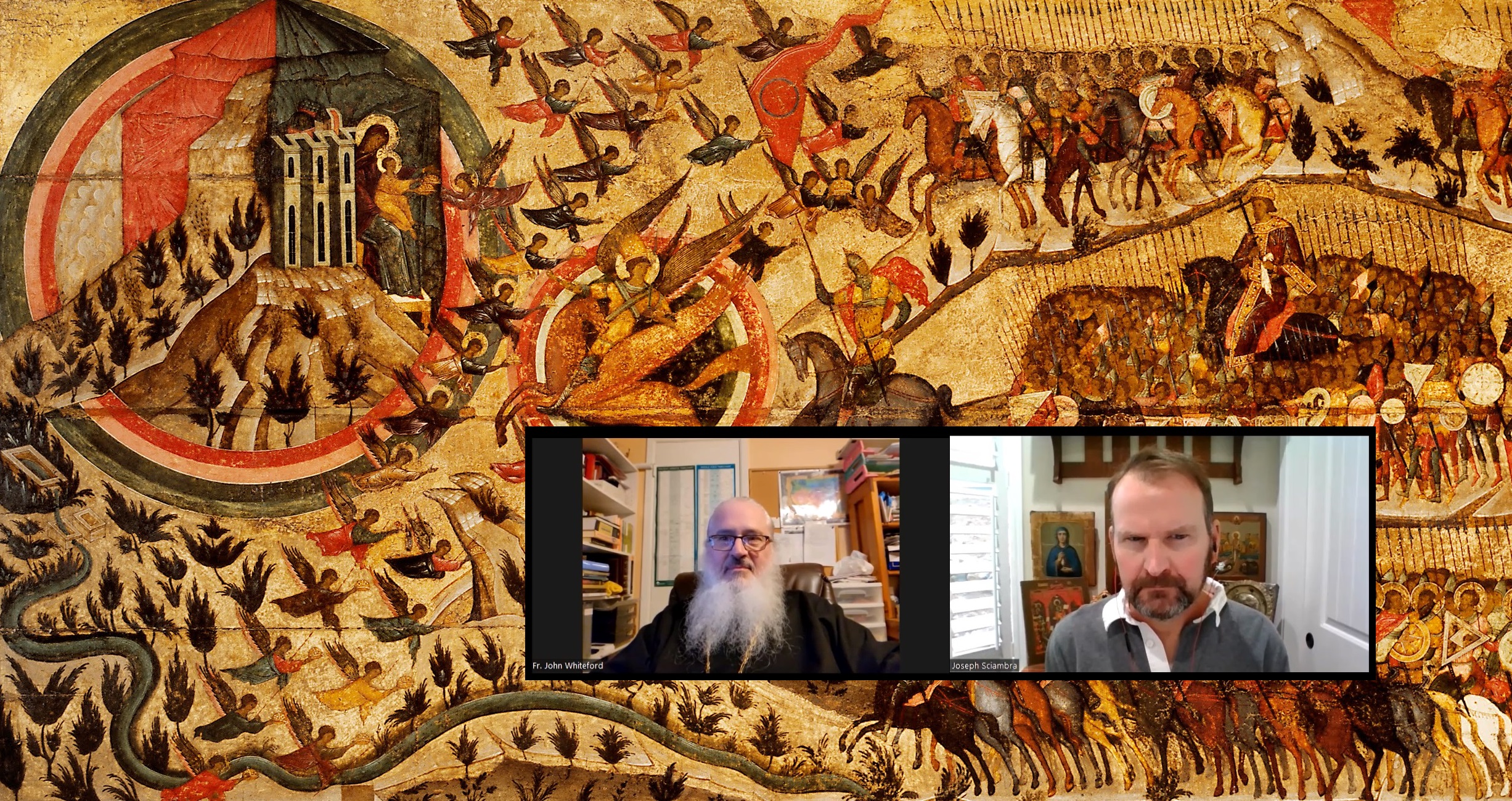
The LGBT War Against Orthodoxy: My Conversation with Fr. John Whiteford
https://www.youtube.com/watch?v=q_ViMQ78Cuk
Saint Joseph Saved My Life
In order to save my life, God sent me the one saint who perfectly exemplified the human attributes that I most feared: FatherhoodMasculinityStrengthBraveryFortitude For as long as I could remember – I yearned to embody
…there but for the grace of God go I.
I never thought I’d be one of those people. I grew up in the North Bay – that largely agricultural, suburban, and affluent section of the San Francisco metro-area that comprises Marin, Sonoma, and Napa
Simplicity and Peace: Surviving Sex, Porn, and Fap Addictions
Give me the strength to seek you; Oh, you who allowed me to find you, and who gave me the hope of finding you more and more. – Saint Augustine For much of my life,